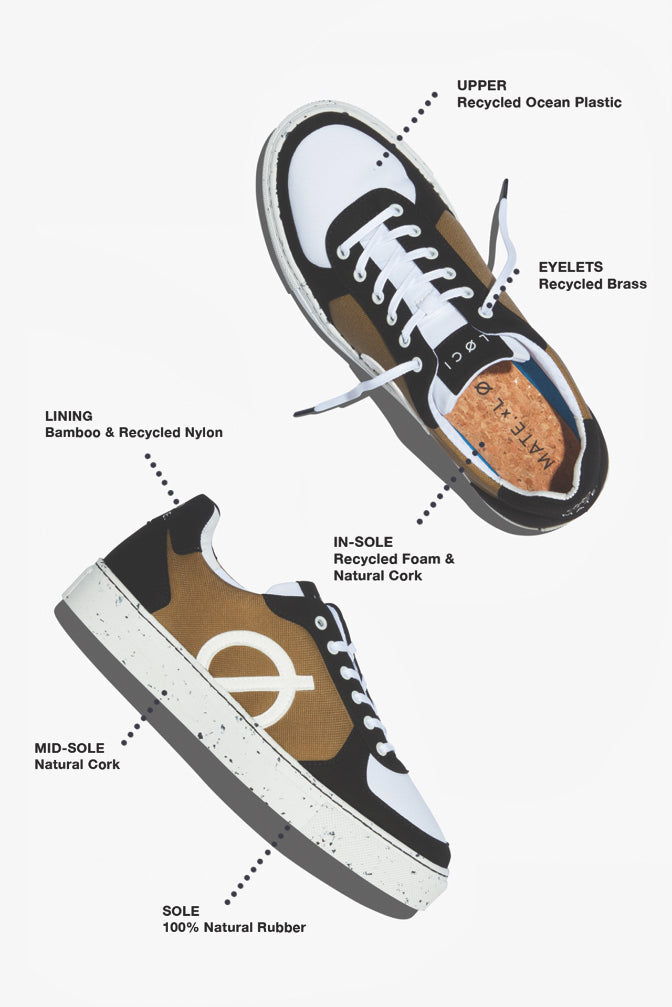


5 Processes Turning Recycled Plastic into Vegan Leather with Premium Performance
Wondering whether leather alternatives can genuinely match the look, feel and durability of real leather? Converting ocean-bound plastic into high-performance material for trainers and accessories demands certified recovery, polymer regeneration, fibre spinning, engineered coatings and rigorous testing.
Read on as we unpack five key processes that shape appearance, mechanical performance and circularity. Trace the journey from recovered plastic to cut, assembled and tested vegan leather, and discover practical choices that reduce waste and extend product life.

1. Recover and Certify Ocean-Sourced Plastic
Ocean-sourced material should mean waste recovered from coastal, riverine or marine waste streams that are at high risk of entering the sea. Rather than relying on marketing language, insist on independent certification and an auditable chain of custody. Ask for verifiable documentation, including batch IDs, audit reports and mass-balance documentation. Look for clear evidence of recovery methods, for example organised beach and river cleans, interceptor programmes, fishing-gear retrieval schemes or coordinated waste-collector networks. Confirm provenance with collection-site coordinates, route logs, photographic records, receipts and proof that local communities were engaged and fairly compensated.
Turning recovered waste into usable feedstock requires staged sorting and decontamination. Begin with manual and mechanical sorting to remove organics, then use density separation to eliminate non-target polymers, followed by high-temperature washing to strip salts and biofilm. Require laboratory confirmation of polymer composition using FTIR or DSC so suppliers can demonstrate the absence of problematic polymers such as PVC. Insist on batch-level traceability, whether via QR codes or ledger entries, and on independent testing for microplastic shedding, abrasion resistance, chemical leachates and heavy metals to compare feedstock quality and predict finished material performance. Finally, vet social and environmental safeguards: ask for proof of fair pay and safe working conditions, independent life cycle assessments that quantify reductions in virgin resin use and greenhouse gas impacts, and transparent disclosure of water and energy use during processing so you can judge trade-offs for yourself.
Use biodegradable, gentle cleaning for safer recycled-material processing

2. Cleaning, sorting and regenerating recycled polymers for circular use
Begin by characterising incoming feedstock with simple analytical tests. Use FTIR (Fourier-transform infrared) or NIR (near-infrared) spectroscopy to identify polymer types, DSC (differential scanning calorimetry) to assess crystallinity, and melt flow index to estimate processability. Use these results to decide whether material can be mechanically reprocessed, requires compatibilisation, or needs chemical regeneration. Remove gross contamination through staged mechanical cleaning. Start with dry separation, friction washing, float-sink tanks and eddy current separators to extract metals, then follow with aqueous washing to strip oils and organic residues. Demonstrate cleaning effectiveness by measuring residual contaminants and odour reduction. Cleaner feedstock reduces smell, improves melt homogeneity and extends the life of downstream equipment. Adopt precision sorting to raise material quality. Combine near-infrared or hyperspectral sensors with X-ray fluorescence to detect additives, and use targeted manual picks for multilayer films and coated textiles. Set practical purity targets, for example greater than 95 per cent single-polymer content for high-performance films. Polymer blend contaminants lead to phase separation, weak interfaces and uneven colour uptake, so precision sorting is essential for reliable recycling outcomes.
Choose the appropriate regeneration route for leather-like materials destined for trainers and sneakers. For relatively clean, high-molecular-weight feedstocks, use mechanical extrusion with filtration, degassing and pelletising. When the feedstock is heavily contaminated or thermally degraded, choose chemical depolymerisation or solvent-based purification instead. Track molecular weight, intrinsic viscosity and contamination markers after regeneration, since these parameters predict tensile strength, flexibility and long-term performance in the finished material. Implement tight quality control and formulation tuning before sheet forming. Thoroughly dry resins to low moisture, measure melt flow index and tensile properties, and add compatibilisers, chain extenders or stabilisers only as needed to reach the target mechanical and colour properties. Validate batches with accelerated ageing, abrasion and colourfastness tests to correlate upstream cleaning and sorting decisions with real-world durability and appearance.
Prefer certified recycled fabrics for consistent, durable finished pieces.

3. Turn recycled polymers into performance fibres built for movement
Producers begin by assessing and restoring the polymer feedstock. They measure intrinsic viscosity or melt flow index, remove contaminants and add chain extenders and stabilisers to recover molecular weight and thermal stability. These interventions markedly improve spinnability and tensile performance. Next, they choose a spinning method to meet the required performance. Melt spinning delivers continuous filament strength. Wet and dry-jet wet spinning are used for higher molecular weight or solvent-soluble polymers. Electrospinning creates ultrafine fibres, allowing precise control over fibre diameter, surface area and hand. Careful control of extrusion temperature, screw shear, spinneret geometry, draw ratio and heat setting orientates polymer chains, enabling tuning of modulus, strength and elongation. Operators validate process settings with tensile testing and differential scanning calorimetry.
Fibre design is tailored to the intended end use. Bicomponent filaments arranged as sheath-core or side-by-side structures can be split into microfibres, producing suede-like softness, improved drape and greater breathability, as shown by microscopy and air permeability measurements. Manufacturers add functional ingredients such as UV stabilisers, antistatic agents and nano-fillers, and apply plasma or corona surface treatments to boost coating adhesion and water repellency. They then perform abrasion, peel and accelerated ageing tests to confirm long-term durability and coating compatibility. Combined, restored polymer chemistry, controlled spinning and post-spinning processes, and targeted surface engineering enable recycled polymers to become performance fibres that match the hand, appearance and durability expected of premium leather, making them suitable for trainers, sneakers and other fashion uses.
Choose durable, heavyweight knitwear for lasting comfort.

4. Engineer coatings and embossing to replicate a premium leather finish
Begin by mapping the multilayer architecture for a leather alternative suitable for trainers. A recycled-plastic base film delivers tensile strength and barrier properties; a textile or foam backing provides bulk and drape; primers promote adhesion; a colour coat sets tone; and the surface finish controls sheen and hand. Measure tensile strength, bending and drape against a premium-leather reference to match stiffness and thickness. Optimise coating chemistry and rheology, since polymer type, molecular weight, crosslink density and plasticiser level all influence hardness, elongation and gloss. Use a design of experiments to screen variables, and include abrasion and colourfastness testing to identify the best formulation. Replicate grain through micro-embossing and macro-embossing with tight control of pressure, temperature and tooling materials. Capture the target topography with a profilometer and iterate embossing parameters until grain depth and pattern fidelity persist after flex testing. Fine-tune surface feel with post-treatments such as microfoaming, calendaring, light buffing and hydrophobic or breathable finishes. Validate each adjustment with contact angle measurements, hand panels and Martindale abrasion tests.
Implement a closed validation loop that combines Martindale abrasion, peel and seam tests, colourfastness to rubbing and light, and accelerated ageing to quantify performance. Use statistical sampling, record process settings for every batch, and map test outcomes back to coating and embossing variables so engineers can refine chemistry, rheology and tooling. This closed loop establishes objective targets for softness, sheen and durability while exposing the trade-offs between flex behaviour and surface fidelity, guiding informed adjustments to meet design and performance goals.
Use certified recycled fleece to validate softness and drape.

5. Cut, assemble, test, and close the loop for trainers
Optimise cutting and nesting with digital nesting, multi-layer cutting or laser cutting to maximise roll usage, seal raw edges and produce repeatable panels that reduce fraying and downstream variability. When developing components for trainers and high tops, match assembly methods to material behaviour by testing ultrasonic welding, hot-melt bonding and stitch patterns on test coupons to compare peel, shear and fatigue performance. Reinforce high-stress zones with bartacks, bonded overlays or folded hems rather than adding non-recyclable inserts. Apply breathable backings, targeted micro-perforation or hydrophobic surface treatments, then validate those finishes with colourfastness, abrasion and cleanability trials to quantify trade-offs between breathability and water resistance. Use compact test rigs, including flex-cycle, abrasion, peel and environmental ageing tests, to replicate walking and laundering stresses, log failure modes and iterate on panel geometry and reinforcement using standard metrics. Engineered for everyday wear, these steps help balance performance, durability and recyclability.
Favour mono-material constructions, modular components and mechanical fastenings to make disassembly straightforward and protect repairability and recyclability. Label materials clearly so they follow recognised recycling routes. Offer repair and take-back schemes and decide whether recovered polymer will return to the upper, the midsole, or be chemically reclaimed. Making end-of-life choices part of material selection creates a feedback loop that lets teams compare material batches and assembly variants with consistent metrics, so design, logistics and testing inform one another. The result is fewer rejects and a stronger circular system for trainers.
The process of turning ocean-bound plastic into leather-like materials blends verified waste recovery with polymer regeneration, fibre engineering, surface coating and disciplined product design to match the appearance, hand and durability of premium leather. Each stage is governed by measurable controls and standard tests to predict performance, quantify trade-offs and reduce environmental impact.
From certified recovery through sorting, spinning, coating and assembly, these five steps underpin traceability, reproducible quality and clearer end-of-life options. Insist on batch-level traceability, third-party test results, mono-material construction and take-back or repair schemes as practical evidence when assessing claims, and favour items that genuinely close the loop.