

What are 10 clear signs plant-based leather is truly sustainable and ethically made?
Plant-based leather can look like an easy environmental win, but provenance, processing and performance are what separate genuine sustainability from clever greenwash. If you care about the planet and ethical labour, how do you spot the plant leathers that actually deliver on those promises?
Use these ten clear, verifiable signs to separate meaningful sustainability from marketing claims: 1. Traceable raw materials and feedstock 2. Prioritised regenerative agriculture and low land impact 3. Confirmed chemical safety and transparency 4. Measured energy, water and carbon footprints 5. Manufacturing transparency with supplier audits 6. Independent certification from recognised bodies 7. Proven durability and repairability 8. Genuine biodegradability or practical recyclability 9. Audited labour conditions and fair practices 10. Independent lab testing with publicly available reports Armed with these criteria and verified lab reports, you can choose materials that combine quality, longevity and social responsibility.

1. Trace raw materials back to their origin to ensure ethical sourcing
Ask for a full supply chain map that lists harvest locations, intermediate handlers and batch or lot codes, and verify chain of custody or mass balance records so the declared feedstock truly originates where claimed. Specify the exact plant species or cultivar and whether the material is a primary crop, coproduct or agricultural waste, and review farm-level records for pesticide use, irrigation type, fertiliser regimes and crop rotation to assess upstream impacts. Where available, obtain GIS coordinates, satellite imagery or independent land-use audits that demonstrate no recent conversion of native habitat, peatland or rainforest, and that the feedstock has not displaced food production.
Start by gathering social and labour documentation from the place of origin, including supplier audits, worker condition reports and evidence of community consent or grievance mechanisms. These records let you evaluate ethical sourcing alongside any environmental claims. Request a full composition breakdown of the finished material, specifying the percentage of plant feedstock versus binders, coatings or plasticisers. Review a life cycle assessment or product environmental report that isolates feedstock impacts on carbon, water and waste footprints. Taken together, traceability records, land-use documentation, social audits and quantified composition data allow you to draw evidence-based conclusions about whether a plant-based leather is genuinely sustainable and ethically produced.
Choose certified knitwear made with recycled materials

2. Prioritise regenerative agriculture to restore soil and reduce land impact
Prioritise feedstock from agricultural byproducts or processing residues rather than crops grown specifically for leather alternatives. Ask suppliers to disclose the percentage of upcycled content and to provide processing facility records and chain of custody documentation so you can confirm production has not expanded land use. Require evidence that growing systems follow regenerative practices, such as cover cropping, no-till cultivation, crop rotation, agroforestry and integrated pest management. Review farm management plans, farmer training records and routine soil test results to verify these practices are being implemented. Demand transparency on land-use change and conversion risk by requesting supplier maps, land-use change assessments and independent satellite or GIS analysis to confirm there has been no recent clearance of natural habitats. Insist on measurable outcomes rather than vague claims: ask for independent ecological audits and routine monitoring records that demonstrate tangible environmental performance.
Insist on lifecycle and land-occupation metrics reported per unit of finished material, for example yield per hectare and land-use intensity. Require manufacturers to publish cradle-to-gate assessments that quantify total land demand and verify there has been no expansion into natural habitats. Look for monitoring data on soil organic carbon trends, water retention, pollinator and invertebrate surveys, and erosion indicators to demonstrate positive ecological outcomes. Favour producers that embed circular practices, such as reusing residues and closed-loop irrigation, and that provide transparent documentation to allow independent, third-party verification.
Choose ethically produced apparel with verified supply chains.

3. Verify chemical safety and confirm materials contain no toxic substances
For responsible sourcing, request a full chemical inventory, Safety Data Sheets and independent laboratory reports that specify analytical methods and limits of detection. Confirm that results quantify, or verify the absence of, known hazards such as phthalates, PFAS, heavy metals, formaldehyde, azo dyes and isocyanates. Ask for a clear breakdown of surface and backing layer chemistries, covering polymers, plasticisers and finishing agents, and favour materials with water-based or solvent-free finishes. Require leaching and degradation tests that replicate realistic use and end-of-life scenarios, with reporting on any toxic breakdown products. Insist on third-party testing for VOC emissions, extractables and migration, analysed using recognised analytical techniques.
To verify on-site chemical management for plant-based leathers used in trainers and other fashion items, ask for an enforced Manufacturing Restricted Substances List, records of waste water treatment and solvent recovery, worker exposure monitoring, and documented training and control measures. Evaluate end-of-life safety with ecotoxicity and leachate testing, clear information on recyclability or emissions from safe incineration, and any independent certification or test protocols that demonstrate decomposition or recycling does not release persistent or bioaccumulative toxins. Prioritise reports from accredited laboratories that include transparent methods and explicit pass criteria; these provide the evidence needed to determine whether a plant-based leather is genuinely sustainable and ethically produced.
Choose ethically certified basics with transparent sourcing.

4. Measure energy use, water footprint, and carbon emissions
Insist on a clear functional unit, for example per square metre of finished material, and require that life cycle assessment results are reported as kg CO2e per square metre, kWh per square metre and litres of water per square metre so comparisons are like for like. Request both cradle to gate and cradle to grave scenarios, plus a sensitivity analysis and defined uncertainty ranges. Prefer primary, measured supplier data on energy use, fuel types and the share of on-site renewable generation rather than industry averages. Cross-check declared energy intensity against the local grid carbon intensity to see how processing emissions are influenced by the electricity source. Ensure carbon accounting follows recognised standards such as ISO 14040 and ISO 14044 or PAS 2050. Require disclosure of Scope 1, Scope 2 and relevant Scope 3 emissions, and seek independent third-party verification or an Environmental Product Declaration.
Measure and report environmental impacts consistently. Report water withdrawal by source and volume per functional unit, and assess water-related impacts by local water stress using recognised tools such as the WRI Aqueduct or the Water Footprint Network. Disclose wastewater quality indicators, including BOD, COD and total suspended solids, and report the extent of on-site treatment or reuse. Specify how biogenic carbon is treated, account for land use change, and state allocation rules for co-products so impacts are comparable across feedstocks. Require transport, packaging and end of life to be included, with modal and distance breakdowns, and report emissions over the product lifetime to reveal hotspots for reduction. Separate sequestration in biomass feedstocks from processing and disposal emissions so trade-offs are clear and reduction opportunities can be prioritised.
Choose ethically made tees with verified supply-chain credentials

5. Demand transparency from manufacturers and routine supplier audits
Start by requesting a full supply-chain map and batch-level traceability, including the names and locations of raw material suppliers, intermediate processors and final factories. Ask for shipment documentation or chain of custody certificates so inputs can be traced back to a named origin; this helps separate genuine closed supply chains from vague claims. Insist on independent third-party audit summaries carried out to recognised standards, together with suppliers' corrective action records and evidence that issues have been closed. A clean audit with documented remediation demonstrates implementation far more convincingly than an unverified statement of compliance.
Require suppliers to provide quantitative environmental and social KPIs with supporting raw monitoring data or third-party verification. Relevant KPIs include energy source mix, water use per kilogram of material, waste diversion rates and basic labour metrics. Insist that contracts include a right-to-audit clause, clear remediation timescales and an independently operated grievance mechanism, and request examples of past grievances and how they were resolved to assess whether policies work in practice. Verify claims through spot checks and independent techniques such as on-site assessments, confidential worker interviews and laboratory tests of finished materials to confirm declared inputs and chemical management. Treat any mismatch between test results, worker testimony and supplier documents as a red flag.
Choose ethically made garments with verified supply-chain transparency.

6. Verify independent certification and compliance with recognised standards
Look for third-party standards that target specific risks. Key types to consider include environmental management certifications that show a facility has systems to reduce impacts; chemical-safety labels that verify finished materials have been tested for restricted substances; circularity claims that assess recyclability and compositional transparency; and social-audit schemes that inspect labour conditions. Match each certificate to the part of the plant-based leather it covers. Product-level verification can differ from a factory management system, and chain of custody or mass-balance claims often apply only to input materials. Coatings, adhesives and trims are frequently excluded from many claims, so do not assume full product coverage. Ask your supplier precise questions about scope. For example, are coatings and trims included? Does the chain of custody use input-tracking or mass-balance? Which feedstock batches are covered? Use those answers to decide which standards matter most for your priorities, whether that is chemical safety, traceability or workers rights.
Quick verification checklist for sustainability and certification claims - Request a copy of the certificate and its registration number. - Confirm the issuer is accredited by the national accreditation body. - Check the certificate scope and its validity period to ensure it covers the material or product in question. - Contact the certifier directly if anything looks inconsistent or unclear. Ask for supporting evidence beyond a logo - Independent laboratory reports for restricted substances. - A concise life-cycle summary that explains key inputs and impacts. - Full audit findings when available. - Traceability records that link feedstock through to the finished material. Watch for red flags - Self-declared labels without third-party verification. - Auditors who lack recognised accreditation. - Certificates that only cover management systems rather than product content. - Unusually narrow scopes that leave major impacts unexamined. Follow up with targeted questions where gaps appear to expose inconsistencies and strengthen the reliability of any claim.
Choose certified recycled-fibre layers for traceable impact.

7. Test durability, repairability and performance during everyday use
Get hands-on. Fold a swatch repeatedly along likely stress points to mimic wear; press with a fingernail or a coin to check scratch resistance; run a rough cloth across high-wear areas to assess abrasion. Watch for surface cracks, peeling or immediate loss of colour, versus materials that spring back and retain their coating, and use those outcomes to judge long-term performance. Finish with simple cleaning trials: place a water droplet to see if it beads or soaks in, blot a mild soapy solution to test stain resistance, and rub a damp white cloth to check for dye transfer.
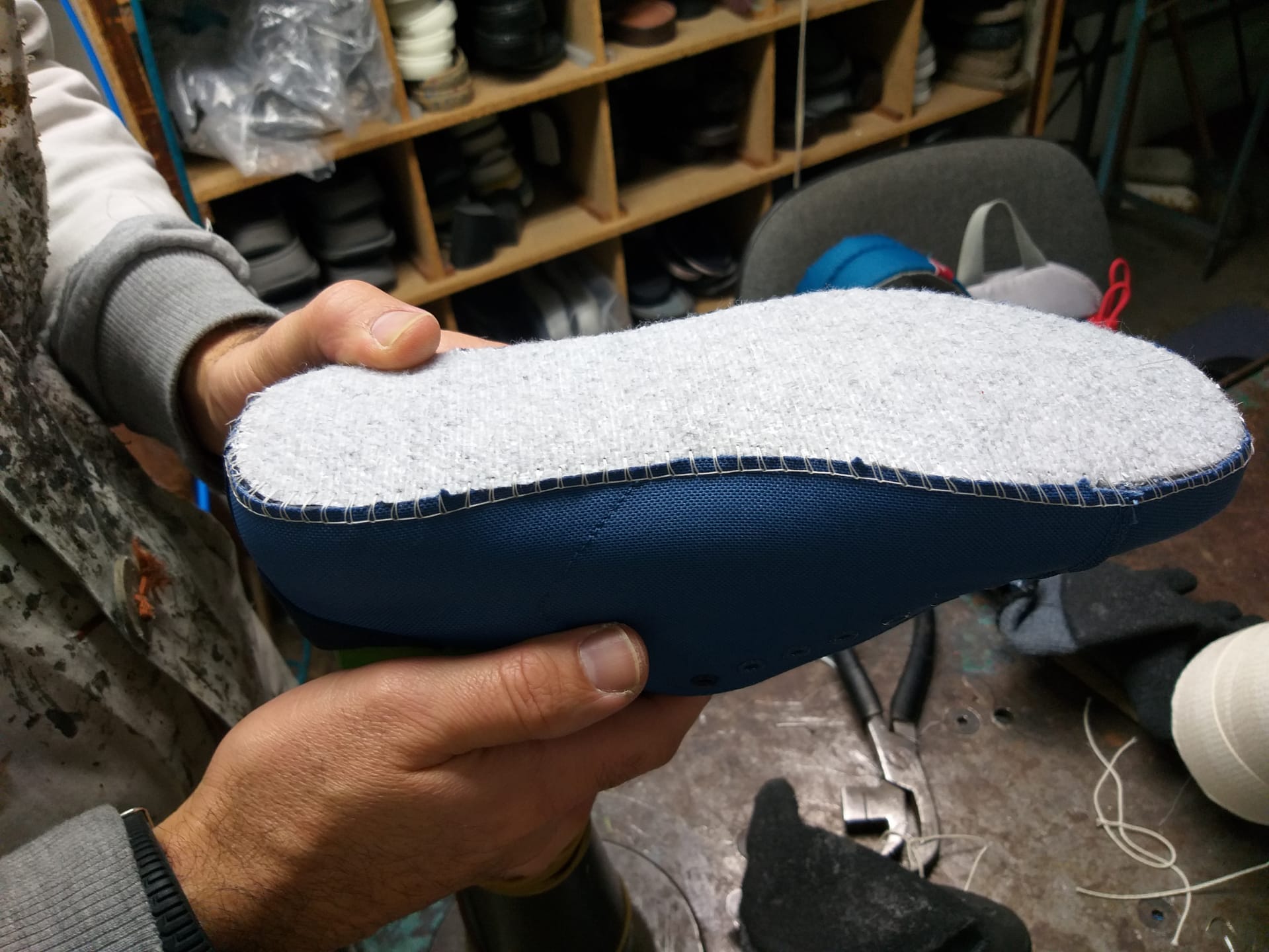
Inspect seams and joins to check whether panels are stitched, riveted or glued. Glued joints commonly delaminate, while stitched seams and mechanical fixings make component replacement and repair far easier. Request independent test reports from suppliers on tensile strength, abrasion resistance, seam and peel strength, colourfastness, biodegradability and microfibre shedding. Verify the standards and test methods cited so you can compare results against your intended use. Simulate real-life wear by subjecting a material swatch to repeated bending, abrasion and cleaning cycles, and assess breathability using a damp pad test. Combine those laboratory and practical findings with warranty terms, return policies and verified user feedback to form a realistic estimate of longevity and likely environmental impact. Taken together, these checks help you choose trainers, sneakers or high tops that are easier to repair, built to last and kinder to the planet.
Choose hard-wearing fleece crafted from recycled fibres.

8. Verify biodegradability and practical recyclability at product end of life
Request independent test reports that quantify biodegradation and recyclability against recognised standards such as EN 13432, ASTM D6400 and ISO 17088. Confirm whether tests were run under the relevant conditions, for example industrial composting, home composting, marine environments or soil. Differentiate compostability from recyclability by asking for a full material breakdown by mass, showing the percentage of natural fibres, synthetic polymers and any coatings, adhesives or pigments that could inhibit biological breakdown or recycling. Be explicit about what is being claimed as compostable or recyclable. Clarify whether recyclability refers to mechanical or chemical routes and request data on recovery rates, yields and the quality of secondary material. Remember that mechanical recycling often downcycles materials, while chemical recycling can reclaim molecular building blocks but typically needs specialised infrastructure. Check local end-of-life pathways with municipal recyclers and specialist textile handlers to confirm whether items are accepted. Ask about any required preparation steps such as separation, labelling or removal of attached hardware. When assessing sneakers, trainers or high tops, ensure test reports and end-of-life checks include multi-component assemblies and any metal or plastic hardware so you have a complete picture of how the item will behave after use.
Ask for evidence of environmental outcomes, not just disappearance. Request analyses of biodegradation by-products, including greenhouse gas emissions, ecotoxicity tests and any persistent residues. Seek life-cycle comparisons that show how composting or recycling a material performs compared with landfilling or incineration, with transparent assumptions and clearly defined system boundaries. Together, these data let you weigh practical end-of-life options and identify materials that can genuinely be composted, recycled or recovered within local high street and municipal systems.
Choose a certified recycled‑blend sweater for more recyclable end‑of‑life.

9. Audit labour conditions to safeguard worker welfare across the supply chain
Map the supply chain down to site level, including subcontractors, labour brokers and processing sites. Verify those links with contracts, delivery records, site photographs and traceability documents so you can pinpoint where workers are actually employed. Reconcile wages and hours against written contracts, payslips, bank transfers, timesheets and social security contributions, and compare actual pay to statutory minimums and independent living wage estimates. Treat recruitment fee deductions or undocumented pay adjustments as immediate red flags. Interview a representative sample of workers in confidence, across roles and shifts, using trusted translators to document freedom to leave, recruitment practices, access to representation and any retaliation.
Inspect health, safety and welfare facilities at workplaces and in any worker accommodation, checking PPE supply, effective machine guards, accessible emergency exits and adequate sanitary facilities. Verify that mandatory rest breaks are enforced and that medical records, incident logs and training records are current and complete. When issues are identified, insist on a written corrective action plan with clear milestones, documented worker input and independent verification. Retain evidence of remediation and follow-up audits. Use worker confirmation, consistent audit findings or a persistent lack of transparency as the basis for procurement decisions.
Choose certified, responsibly sourced basics for ethical procurement.

10. Demand independent lab testing and transparent public reports
Demand reports from independent, accredited laboratories and verify credentials such as ISO 17025, valid contact details, and a documented chain of custody so every tested sample can be traced back to a specific production batch. Clearly specify the tests required and what each demonstrates: heavy metals and restricted additives for human and environmental toxicity; volatile organic compounds and solvent residues for indoor air quality and worker safety; abrasion and laundering tests to assess microplastic shedding; and biodegradation or compostability trials under realistic environmental conditions to show end of life behaviour. Insist that results represent typical production rather than cherry-picked examples by requiring randomised sampling across multiple batches, clear sample IDs and batch numbers, and suitable numbers of replicates and control materials.
Insist on open, machine-readable reporting that includes full raw data, a methods section, detection limits, and the statistical analysis, along with an executive summary that ties findings to relevant standards or regulatory limits and a declared conflict of interest from the commissioning party. Require transparent test methods and sample protocols so outcomes can be judged representative, and seek an independent auditor statement or verification mark to strengthen credibility. Build ongoing verification into the process by mandating periodic retesting or unannounced spot checks by different accredited laboratories, insisting on traceability between sold items and tested samples, and publishing a corrective action plan when results exceed defined thresholds.
Genuine sustainability for plant-based leather depends on verifiable evidence, not marketing. Demand traceable feedstock, transparent processing, quantified environmental footprints and independent testing to uncover real impacts. Request supply chain maps, accredited laboratory reports, life-cycle assessments and audited labour records so vague claims become measurable criteria you can compare.
From regenerative agriculture and chemical safety to durability, recyclability and worker welfare, these ten headings form a practical, data-driven checklist. Apply it when assessing or procuring materials: insist on raw data and independent verification, and favour options that demonstrate lasting durability and responsible end-of-life outcomes.